Saturday, January 9, 2016

John Byrom (Shorthand Part 12)


John Byrom (1692—1763) was leap year baby born on February 29, 1692, near Manchester to a prosperous merchant. He entered Trinity College, Cambridge, in 1708. He received his B.A. in 1712 and M.A. in 1715. The development of his shorthand system started while he was in college. Robert Roffe in Stenographical Accidence, or Byrom’s System of Shorthand Made Easy (1813) states:
“The first occasion of Byrom’s turning his attention to the study of shorthand arose from his acquaintance with Mr. Sharpe at Trinity College, Cambridge. This gentleman’s father, at that time Archbishop of York, had recommended to his son to make himself master of shorthand as an art very useful and commodious. Incited by an authority so respectable, the two friends applied themselves to the study of the method then in vogue, but Mr. Byrom was so disgusted with the absurdity and awkwardness of its contrivances, that he soon threw it aside. Smitten, however, with the idea of an art so useful in life and so capable, in his opinion, of being brought to much greater perfection he consulted everything that could by procured, either in print or manuscript, which has been written on the subject; but finding them all, however, differing in trifling circumstances, equally arbitrary, inartificial, and defective in their first principles, he resolved no attempt a system of his own, upon a more natural, rational and philosophical plan. His system was completed as early as the year 1720.”
In 1716, he travelled to Montpelier, France and studied medicine and took up an interest in poetry. Byrom returned to London in 1718 without taking an M.D. degree, and declined an offer to practice medicine in Manchester. Thereafter, he was called “doctor” by his friends.

Byrom married his cousin, Elizabeth Byrom, on February 14, 1721. She was the daughter of Joseph Byrom, his father’s younger brother. The marriage did receive consent of her parents though the opposite has been alleged in some biographies.

Further, some biographies assert that Byrom’s marriage left him without support from the family estates or her parents and that he resorted to teaching shorthand as a means of income.  However, if we look at the facts a more reasonable explanation would be he had other means of supporting his wife and children and was attracted to teaching shorthand due to his interests.

Byrom first taught his shorthand in Manchester, and after success went to London. Once in London, his connections at Cambridge were helpful in introducing him to prominent members of society: Horace Walpole, Lord Conway, the Wesley brothers, Lord Chesterfield, the duke of Devonshire, Lord Camden, and others.

Shorthand probably secured his Fellowship to the Royal Society in March 1724—Sir Isaac Newton was the society’s president at the time.  Byrom also founded the first stenographic club, a Shorthand Society, for his shorthand system on February 28, 1726.

John Byrom had a serious rivalry with James Weston. The two often contested about the superiority of their respective system. Weston challenged Byrom to a writing contest with a 50 guineas to 1 that his system is as speedy or legible as Byrom’s. The contest never took place, though many shorthand histories state that the two did meet and Weston lost.  The main proof to the lack of a contest is Weston is still challenging Byrom in 1742 when Byrom has stopped is active involvement in shorthand (see following paragraph).

After the death of his older brother, Edward, in May 1740, Byrom inherited all of the family estates, and he lost interest in teaching and furthering shorthand. Byrom never published his system during the remainder of his life and instead enjoyed social and domestic life. On September 26, 1763, John Byrom died after a lingering illness.


1767 New Universal Shorthand:
John Byrom’s manuscripts were made into the New Universal Shorthand and published in 1767, four years after his death. The writing principles were:

  1. A complete word must be written without taking off the pen.
  2. The writing should by lineal—not rising above or sinking below two parallel lines without being crowded.
  3. Abbreviations should expressed by alphabet letters and be founded on the properties of the language.
  4. There should be no arbitrary marks or signs

The Alphabet:


Vowels:
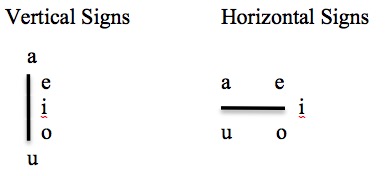
The vowels, when expressed (i.e., initial or final vowels were generally expressed and the medial vowels omitted), were represented by a dot in written next to the consonant in five positions based on vowel spelling (single vowels) or nearest sound (e.g., A for ai, au, aw, and ay). Shorthand experts have noted that practically it is impossible to observe more than three positions: beginning, middle, and end.

For vertical and horizontal signs, if the dot was placed to the left or above the sign then the vowel occurred before the consonant. If the dot was placed to the right or below the sign, then the vowel occurred after the consonant.

Unfortunately for curved consonants, this vowel pattern did not continue. Instead A, E, and I are written above the consonant and O and U below the consonant when the vowel occurred before the consonant. The opposite was used when the vowel occurred after the consonant. A bit confusing to the learner to say the least. Later adapters used the consistent horizontal signs pattern for curved consonants.


References:

  1. Dictionary of National Biography. 2nd Edition. (1908-1909). Vol 3, 581-4
  2. Historical Account of the Rise and Fall of Shorthand by James Henry Lewis. 1816 
  3. The History of Short-hand Writing by Matthias Levy. 1862
  4. The Story of British Shorthand by Edward H. Butler. 1951. Pages 44 to 55.

Sunday, January 3, 2016

Thomas Gurney and Family (Shorthand Part 11)


Thomas Gurney (1705—1770) was born into a large family on March 7, 1705, in Woburn, Bedfordshire. He was a descendant of Hugh de Gourney, a Norman baron who fought under William the Conqueror at the Battle of Hastings in 1066.

His initial contact with shorthand was accidental. Gurney desired a book on astrology and to acquire one bought a group of books. One of the books was William Mason’s La Plume Volante. He studied and applied himself to it, and at the age of sixteen began recording sermons.

Gurney moved to London in 1737 working as a clockmaker and watchmaker.  He also continued his shorthand by recording trails at the Old Bailey. According to his own statement (Brachygraphy, fourth edition, 1760), he was appointed shorthand writer to the Old Bailey Court in 1748 making Thomas Gurney the first official shorthand writer for the English government. Afterwards Gurney practiced in other courts and in the House of Commons as the first official Parliamentary recorder.

Thomas Gurney founded a reporting firm, Gurney & Sons, which would be the official shorthand reporters to the courts and Houses of Parliament for about 150 years. Thomas Gurney held his appointment at the Old Bailey until his death on June 22, 1770.

The firm Gurney & Sons would be family-run for five generations, 166 years. Leadership of the firm passed from Thomas Gurney to his son Joseph in 1770, to his son William Brodie in 1813, to his son Joseph in 1855, to his nephew William Henry Gurney-Salter in 1879, to his cousin William Gurney-Angus 1912. Leadership of the firm passed out of family hands in 1914 to Walter Hodgson.

1778 Brachygraphy:
Thomas Gurney's system, Brachygraphy, made Mason's La Plume Volante practical by removing most of the arbitrary characters and shortening rules. The system is relatively easy to learn, but for verbatim work it means a person needs to be rather dexterous because words must be spelled out.


Initial vowels were expressed by alphabet sign. Medial vowels were generally not expressed, but when expressed it was by “Vowel Mode” using Mason’s three positions based on spelling or best represented sound. Therefore, the three positions expressed short and long vowels and diphthongs. Final vowels were expressed by a dot in the Vowel Mode position. By omitting medial vowels, Gurney was able to join many words into a single, continuous outline. The advantage is speed, which he needed for verbatim reporting.  The disadvantage is ambiguity in reading.


References:

  1. Dictionary of National Biography. 2nd Edition. (1908-1909). Vol 8, page 568.
  2. The History of Short-hand Writing by Matthias Levy. 1862.
  3. The Story of British Shorthand by Edward H. Butler. 1951. Pages 56-62, 198, and 199.
  4. 1778 Brachygraphy

Saturday, January 2, 2016

William Mason (Shorthand Part 10)


While little is known about the life of William Mason (fl. 1672-1709), a writing instructor and stenographer who lived in London. Virtually everything we know about Mason comes from his books, especially the preface of his La Plume Volante which reads:
“Having delighted in the art of shorthand from my youth, I practiced it for some time according to the various rules that were published by divers authors, before I attempted to compose any method of my own. The first book of this kind which I ventured into the world was entitled "A Pen Plucked from an Eagle's Wing," which was chiefly founded on Mr. Rich's scheme, whose shorthand at that time was very much in vogue: but the experience of a few years convinced me that his basis was too narrow, which induced me to betake myself to the study of a new foundation, upon which I built with better success. This new method I published under the title of "Art's Advancement," which has found no unkind treatment in the world, as appears by the considerable numbers that have been printed for more than twenty years together.  
Not yet content with the progress I had made in cultivating this art, I applied myself to the further improvement of it, and persuade myself that the method I now publish, which I taught in manuscript for fifteen years past, has brought it many degrees nearer to perfection than any that has yet been exposed to the world.”
William Mason learned shorthand as a youth, probably around 1659. In 1672 he published A Pen Plucked from an Eagle's Wing, a system based on Rich’s The Pen’s Dexterity. Dissatisfied with it, Mason developed a new system based on a “new foundation,” and published it as Art's Advancement in 1682.

Mason “applied [himself] to the further improvement” of his system and published a corrected and enlarged edition of Art's Advancement in 1687.  Not satisfied, he improved it further and started teaching the manuscript form of  La Plume Volante in 1692. Lastly, Mason published La Plume Volante in 1707.

1707 La Plume Volante:
Mason’s 1707 La Plume Volante ran through five editions. The Fifth Edition, “with the addition of the terms of the Law and much amended,” was published in 1719.


Vowel Expression:
Initial vowels were expressed by alphabet sign. Medial vowels were expressed by “Vowel Mode” using the following three positions based on spelling or best represented sound. Therefore, the three positions expressed short and long vowels and diphthongs. Final vowels were expressed by a dot in the Vowel Mode position.


Other:
The system had many “rules:” 17 terminative (suffix) rules, 25 rules of contraction, and abbreviating rules. The student needed to memorize 64 prepositions and suffixes as well as 423 arbitraries and symbols.


References:

  1. Dictionary of National Biography. 2nd Edition. 1901, Vol. 12, Pages 1322.
  2. The History of Short-hand Writing by Matthias Levy. 1862. Pages 50-2.
  3. The Story of British Shorthand by Edward H. Butler. 1951. Pages 40, 57, 61, and 206.
  4. A Critical and Historical Account of the Art of Shorthand” The National Stenographer. Apr 1892.
  5. La Plume Volante. (5th Ed, 1734).


Monday, November 23, 2015

Other Shorthand Improvements Between 1602 and 1707 (Shorthand Part 9)

1644 — Theophilus Metcalf 
Theophilus Metcalfe published the 6th edition of his Radio-Stenography in 1645. He is the first author to suggest leaving out the small words "the" and "of," words that can be supplied from context or memory to speed writing.

1659 — Noah Bridges
Noah Bridges published Stenographie and Cryptographie in 1659. His is the first system to represent medial vowels with dots. He represented initial vowels by alphabet sign and final vowels with dots.

1674 — Elisha Coles
Elisha Coles published The Newest, Plainest and Shortest Shorthand in 1674. Coles was the first shorthand author to suggest position writing or writing on ruled paper which gives three distinct writing positions: above the line, on the line, and below the line.

Coles thought the greatest obstacle to shorthand speed was monosyllables. In his system, writing a vowel sign above, on, or below the line corresponded to certain monosyllabic words. For example, an A written above the line represented the words add, aid, and, age, arch, ash, ark, and ask.

Sunday, November 22, 2015

Jeremiah Rich (Shorthand Part 8)


Summary:
Jeremiah Rich (d. ~1660) was most likely from a good family because he dedicated his 1659 Penns Dexterity to the “Right Honourable Lady Mary Rich,” the Countess of Warwick and a likely relative with whom he probably lived as a tutor. Rich learned shorthand from his uncle, William Cartwright, became a well-known practitioner, and is one of the earliest known reporters of trails. Jeremiah Rich published his shorthand system in the following books:
Semography in 1642.
Charactery in 1646.
Semigraphy or Arts Rarity in 1654.
The World’s Rarity before 1660.
The Penns [Pen's] Dexterity in 1659.

Unfortunately, Jeremiah Rich was not the inventor of his shorthand system; it was developed by his uncle, William Cartwright. While Rich published Semography, the author of the system is clearly William Cartwright. The later portion of Semography’s subtitle reads:
"…Invented and composed for the benefit of others by the Author hereof William Cartwright, and is now set forth and published by his nephew, Ieremiah Rich, immediate next to the Author deceased…"
While Jeremiah Rich did not author the system, he did popularize it. Cornelius Walford, a President of the Shorthand Society of London, in The Phonetic Journal (Feb. 21, 1885) stated:
“[Jeremiah] Rich did a great deal to popularize stenography in the United Kingdom during the second half of the 17th century is absolutely clear; and I have reason to suppose from various manuscripts and shorthand notes in books that a great many of the learned professors at the Universities became familiar with and practiced his system.”

Pen's Dexterity Alphabet:
The alphabet is based on the 1627 alphabet of Edmond Willis 


Pen's Dexterity Vowel Expression:
Initial vowels were expressed by alphabet sign. Medial vowels were expressed by “Vowel Mode” using the following four positions based on spelling or best represented sound. Final vowels were expressed by dots in the Vowel Mode position. The vowel E was omitted it for ef-, el-, em-, en-, er-. es-, ex-, be-, de-, ge-, pe-, and te-. When written medially, E was represented by a small joined circle. Final E was written as a dot in the I vowel position.


Resources:
1. Dictionary of National Biography2nd Edition (1909), Vol. 16, page 1000-1001
2. A History of Shorthand by Isaac Pitman (1891), page 21 to 26
3. “A Critical and Historical Account of the Art of Shorthand” The National Stenographer
    (Dec 1882)
4. Story of British Shorthand by Edward Butler. 1951. Pages 38 to 40.
5. Pen’s Dexterity (1690)

Saturday, November 21, 2015

Thomas Shelton (Shorthand Part 7)


Summary:
While Thomas Shelton (1601 to 1650) came from an affluent Norfolk family, he himself was not of independent means.

Thomas Shelton published “Short Writing” in 1626 (2nd Ed 1630; 3rd Ed 1636). Shelton improved his shorthand system and published his most well known work “Tachygraphy” in 1638. It was republished in 1641 along with a primer, “A Tutor of Tachygraphy” (1642). Tachygraphy was popular with more than twenty editions between 1641 and 1710. Thomas Shelton published “Zeiglographia” in 1650.

Tachygraphy Alphabet:


The Tachygraphy alphabet is based on the 1627 alphabet of Edmond Willis. The alphabet signs were written all the same size, unlike the previous systems where the first alphabet sign was written large than the rest to indicate where the outline began.

Tachygraphy contained improvements like excluding the E from the prefixes of em-, en-, es-, and ex-. It also contained about 300 symbols for common words and suffixes that a student had to learn by rote.


Tachygraphy Vowel Expression:
Initial vowels were expressed by alphabet sign. Medial vowels were expressed by “Vowel Mode” using the following five positions based on spelling or best represented sound. Final vowels were expressed by dots in the Vowel Mode position.


Resources:
1. Dictionary of National Biography. 2nd Edition (1909). Vol. 18, pgs. 45 & 46.
2. A History of Shorthand by Isaac Pitman (1891)
3. “A Critical and Historical Account of the Art of Shorthand” The National Stenographer
    (Nov 1882)
4. Story of British Shorthand by Edward Butler. 1951. Pgs. 26 to 28.
5. A Tutor of Tachygraphy, 1642

Saturday, June 13, 2015

Edmond Willis (Shorthand Part 6)

Summary:
Little is know about the life of Edmond Willis.  There is even a question if he was related to John Willis.  Most sources say there was no relationship between the two men or the relationship is unknown.

Edmond Willis published the first edition of “An Abbreviation of Writing by Character” in 1618. This edition was based on John Willis' Shorthand system, and some authors consider it only a slight modification of John Willis' system. While this is true for the overall system, Edmond Willis did completely change the alphabet signs.

In 1627, Edmond Willis published the second edition.  The alphabet was basically the same as the 1618 alphabet with only the signs for O, R, and T being altered. It also contained signs for double and triple consonants that began or ended words, prefixes and suffixes, and about 200 arbitraries.

1627 Alphabet:


Edmond Willis also had signs for CH, SH, and TH in the 1627 alphabet:


ch

sh


th


1627 Vowel Expression:
Vowels were expressed by “Vowel Mode” which is the disjoining of a succeeding consonant and placing it against the preceding consonant in a particular position.  Different position represent different vowels.


Resources:
1. The Bibliography of Shorthand by John Westby-Gibson (1887)
2. Historical Account of the Rise and Fall of Shorthand by James Henry Lewis (1816)
3. “The History of Short-hand Writing” by Matthias Levy (1862)
4. “Shorthand: A Scientific Magazine” Vol. 3 by Shorthand Society (1889).
    (Search for "Edmond Willis')
5. A History of Shorthand by Isaac Pitman (1891)
6. "Shorthand." Chambers's Encyclopedia. (1892. Vol. 9, page 414)
7. “A Critical and Historical Account of the Art of Shorthand” The National Stenographer
    (Nov 1882)
8. Story of British Shorthand by Edward Butler. 1951. Pgs. 25, 26, and 204.